

Last updated October 30, 2026
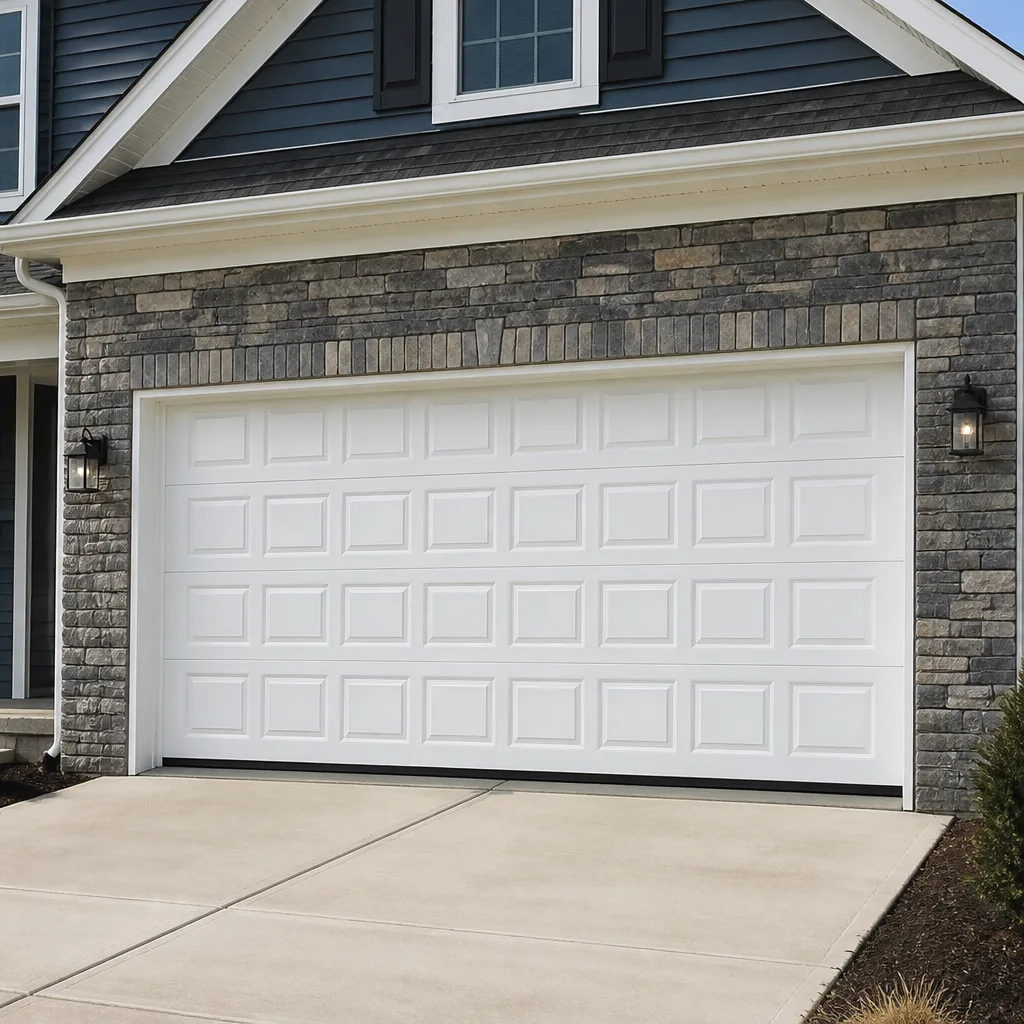 Raised-panel steel
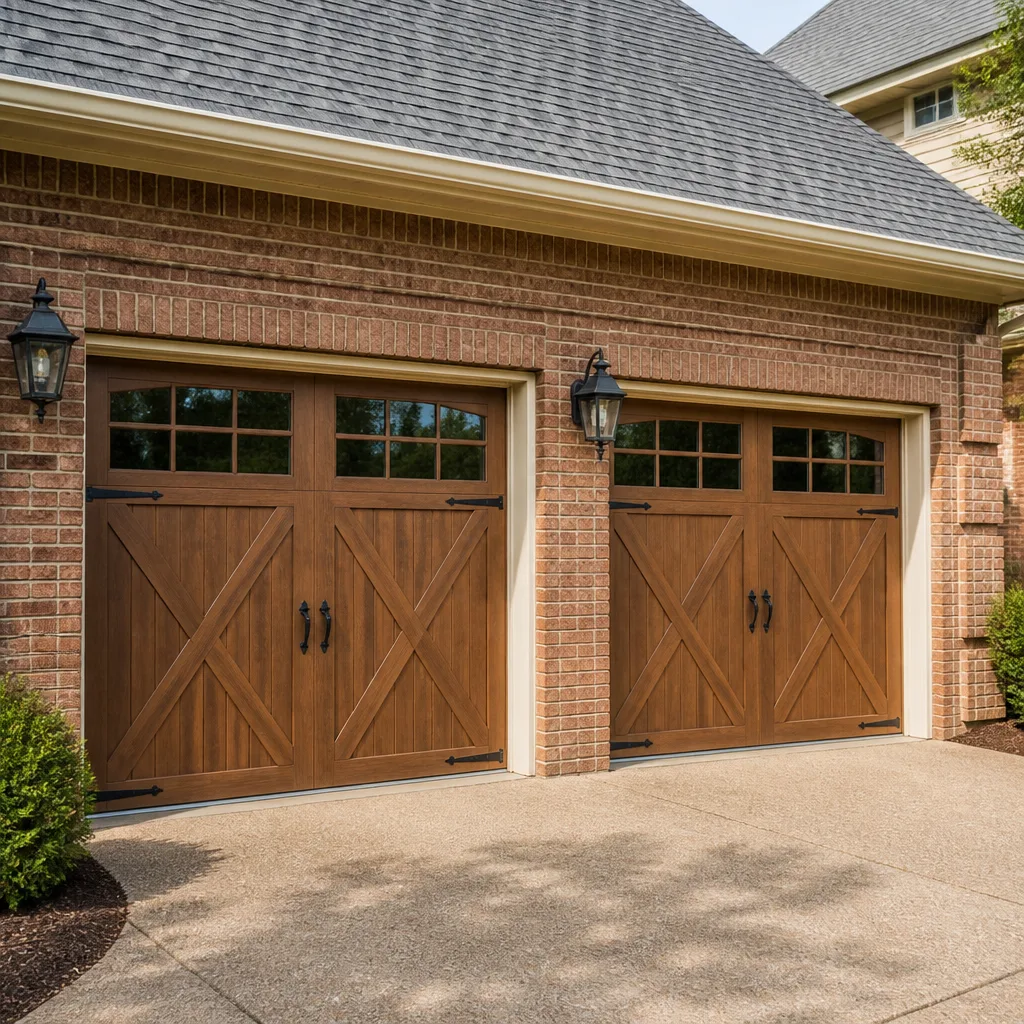 Carriage house
 Modern flush
 Full-view glass
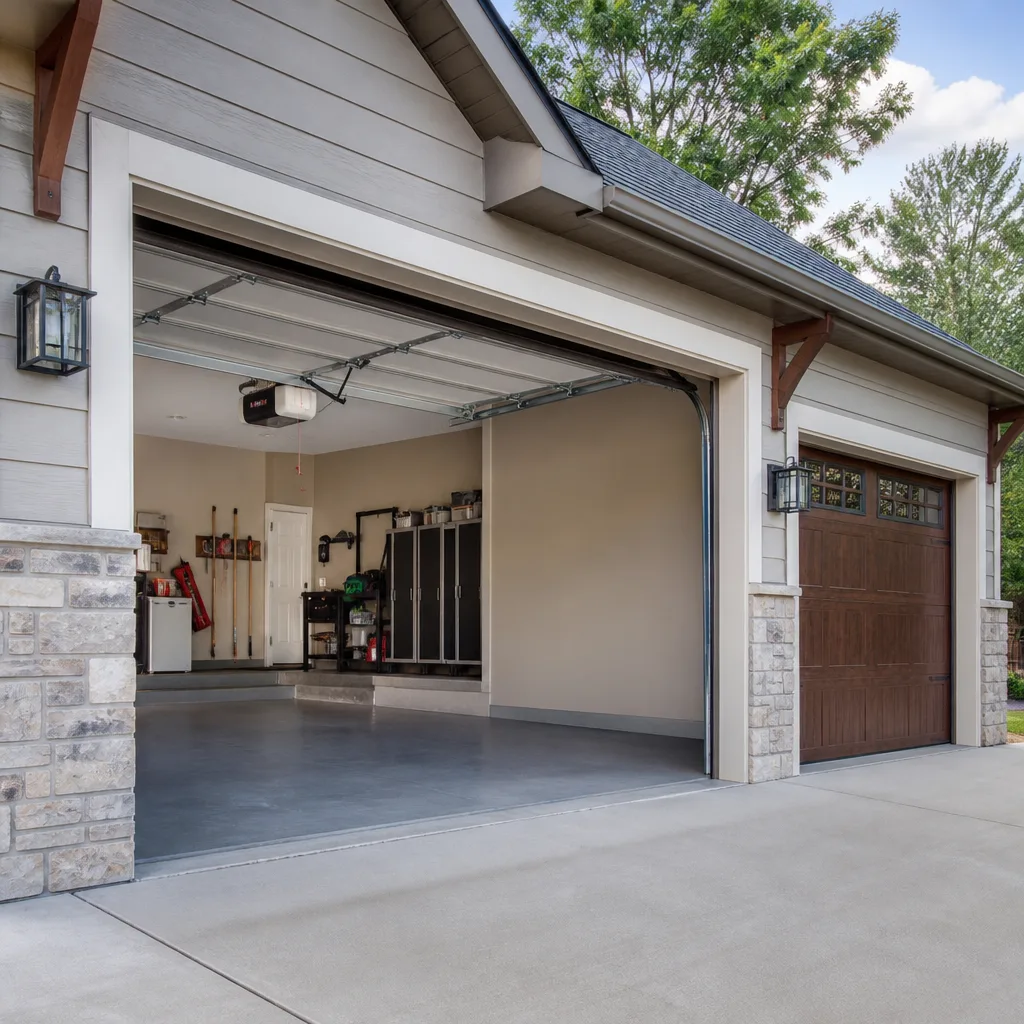 LiftMaster openers
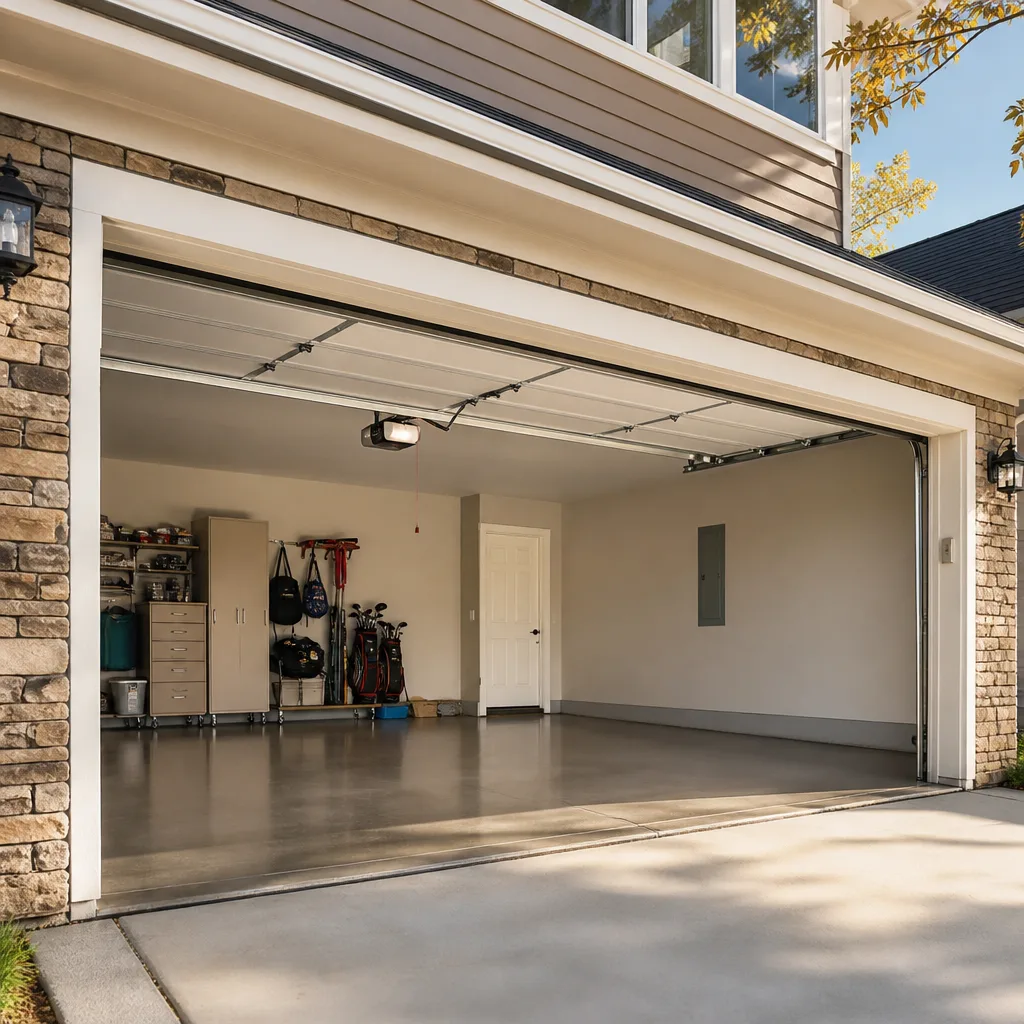 Chamberlain openers
Full 25-point door and opener safety check with every visit - springs, cables, rollers, tracks, and your LiftMaster or Chamberlain opener included
You get a price before we start. It does not change when the truck arrives.
Get your free estimateDIY vs Professional Garage Door: The Brushy Creek Homeowner’s Decision Guide
A torsion spring wound to full tension stores roughly the same kinetic energy as a fired .22 caliber round. YouTube will happily show you how to adjust one with a pair of winding bars and a step stool, and it will never once mention that fact. This guide exists because we’ve seen what happens in Brushy Creek garages when that disconnect meets a humid Texas afternoon and a door that suddenly weighs 180 pounds. You’ll learn which garage door tasks are genuinely safe for a competent homeowner, which ones are not, and how to tell the difference before you touch a single bolt.
Quick Answer
Roughly 80% of garage door maintenance in Brushy Creek is safe for a homeowner with basic tools: lubrication, sensor realignment, remote programming, weatherstripping. The other 20% – springs, cables, bottom brackets, and anything connected to them – operates under stored mechanical energy and should be handled by a trained professional. The dividing line is not your skill level. It is whether the component you’re touching is under load.
Styles & brands we work with
Table of Contents
- The Component-by-Component Safety Matrix
- Why Stored Energy Changes Everything
- Spring Work: What YouTube Doesn’t Show You
- Tasks a Brushy Creek Homeowner Can Safely Handle
- The Hidden Cost of a Bad Adjustment
- Brushy Creek Warranty Implications: LiftMaster, Chamberlain, Genie
- What Professional Training Actually Adds Beyond Technique
- A Decision Framework for Any Garage Door Problem
The Component-by-Component Safety Matrix
Every garage door has roughly a dozen components that can fail or need maintenance. Some are inert pieces of hardware. Others are actively holding the weight of a 150-to-200-pound door, or storing enough torsion to move it. The matrix below separates them clearly, because the single most useful thing a Brushy Creek homeowner can do is sort a problem into the right column before taking any action.
Safe for Homeowner (No Stored Energy)
- Lubricating rollers, hinges, and tracks – Low risk. Use a lithium or silicone spray, not WD-40. Apply to moving metal parts twice a year in the Brushy Creek climate, where summer heat accelerates grease breakdown and winter cold stiffens it.
- Realigning photo-eye sensors – If the door reverses before closing, the sensors are usually the culprit. They’re low-voltage, they don’t hold tension, and realignment typically takes ten minutes with a screwdriver.
- Programming remotes and keypads – Every major brand has a specific but simple sequence. We work on LiftMaster, Chamberlain, and Genie openers constantly, and on those three the learning procedure is well documented in the manual or on a sticker on the motor unit.
- Replacing weatherstripping and bottom seals – Cosmetic and protective, no mechanical risk. Important in Brushy Creek for keeping summer dust and occasional heavy rain out of the garage.
- Tightening loose bolts on the track brackets – As long as you’re not touching the bottom bracket where the cable attaches (see below), this is safe. Use a socket wrench and check for rust while you’re up there.
- Visual inspection – Everyone should do this quarterly. Look for frayed cables, rust on springs, worn rollers, and track misalignment. Spotting a problem early means a $120 repair instead of a $600 one.
Professional Only (Stored Energy or High Risk)
- Torsion springs – The single most dangerous component in any home. We’ll address this in depth below.
- Extension springs – Same stored energy, different configuration. Older Brushy Creek homes built in the 1980s and 1990s often have these on single doors.
- Cables – They run through the spring system and carry the door’s weight when the spring is under tension. A cable that snaps while you’re inspecting it is a whip moving at hundreds of feet per second. One that snaps during a DIY spring attempt is worse.
- Bottom bracket bolts – These attach the cable to the bottom of the door. Removing one without understanding what it’s holding can drop the entire door or release the spring tension catastrophically. This is a component nearly every homeowner overlooks, and it is among the most dangerous.
- Track replacement or major realignment – The door weighs more than you think. A track that comes loose during adjustment can pin a person.
- Opener motor or logic board replacement – Moderate physical risk, high cost risk. A miswired opener can fry the board, and a misinstalled one can drop the door on a car or a person. Our garage door opener repair in Brushy Creek practice regularly replaces motors and boards that homeowners damaged while attempting self-repair.
The pattern here is not subtle. If the component stores energy – a spring, a cable under tension, a bracket holding that cable – it belongs in the professional column. If it’s a static piece of metal or a low-voltage electronic component, it belongs in the homeowner column. The matrix holds true regardless of how handy you are.
Why Stored Energy Changes Everything
Most home repair advice is skill-based: if you can follow instructions, you can probably do it. Garage doors break that model because the danger is not about competence. It’s about physics. A door that weighs 160 pounds is counterbalanced by a spring system that stores enough energy to move that door – roughly 400 to 800 pounds of force depending on the door size and spring configuration. That energy is stored in the spring at all times, even when the door is sitting still, even when the power is out, even when the car isn’t in the garage.
Think of it like this: a circular saw is dangerous while it’s running, and safe when it’s unplugged. A garage door spring is dangerous at rest. There is no unplugging it. The only way to release that energy safely is with winding bars and a precise sequence of measured turns, and the only way to restore it is with the same tools and the same precision in reverse. Get the count wrong by half a turn and the door may not balance. Get it wrong by two turns and the door may fly up. Get it wrong while the bar is still in the cone and the bar becomes a projectile.
In Brushy Creek, we see a lot of doors that were originally installed by builders in the 1990s and early 2000s. Those doors are now 20 to 30 years old. The original springs have often been replaced once already, or they’re due. Older spring cones have set screws, and those screws strip or loosen with thermal expansion and contraction. A homeowner who watches a tutorial filmed on a newer door in a cooler climate may not realize that their specific cone style requires a different technique, or that the set screw is already compromised and about to fail during adjustment. That specific mismatch – old hardware, generic video, high humidity, hot garage – is a recipe for an injury we’d rather prevent.
This is not gatekeeping. We are a garage door company, and we would prefer to earn your business by fixing what needs fixing, not by convincing you that everything is dangerous. But the stored-energy components are genuinely different from every other home repair task, and that difference is the entire point of this guide.
Spring Work: What YouTube Doesn’t Show You
There are dozens of garage door spring tutorials online. Some of them are filmed by actual professionals. Many of them are filmed by homeowners who have successfully replaced one or two springs and decided to share. The problem is that a video can show you the sequence of turns, the position of the winding bars, and the direction of rotation – and still leave out everything that actually matters on the ground.
Here’s what the videos don’t show:
- How to diagnose the correct spring size. Springs are sized by wire gauge, inside diameter, and length. Order the wrong one and the door won’t balance, the opener will strain, and the new spring will fail early. A professional measures the old spring and verifies against the door weight. A tutorial says “measure it,” then shows a tape measure on an already-removed spring as if the hard part had already been done.
- What happens when the set screw strips mid-wind. This is the most common failure we see in DIY spring attempts, and no tutorial addresses it because the fix requires removing a damaged cone and replacing it – not something a homeowner with two winding bars can do.
- How to handle a spring that breaks while you’re unwinding it. Old springs sometimes snap during removal. They were going to snap anyway, but if it happens while you’re holding a winding bar, the bar exits the cone with significant force. A professional knows how to position their body and the ladder so that this exact failure mode moves the bar away from them, not into them.
- What the door should feel like when it’s correctly balanced. This is the most important skill in the entire trade, and it can’t be learned from video. A correctly balanced door stays where you put it by hand across the full range of travel. It doesn’t rise on its own, it doesn’t sink, it doesn’t feel heavy halfway through the opening arc. You can only develop this feel by doing it hundreds of times.
- How to verify cable tension on both sides simultaneously. A door with one side wound slightly tighter will pull to one side. The cables must be tensioned uniformly, and that requires checking both sides during the wind – something that is awkward to describe and impossible to show from the angle most tutorials are filmed at.
We’ve serviced doors in Brushy Creek where a homeowner replaced their own spring, got the door balanced enough to open and close, and called us three weeks later because the door was suddenly grinding. What they didn’t know is that their “good enough” spring left the door three pounds heavy on one side, and the opener motor had been compensating for that imbalance every single cycle. That is the hidden cost we’ll address next.
Tasks a Brushy Creek Homeowner Can Safely Handle
Nothing above is meant to discourage you from working on your own garage door. Quite the opposite. There are tasks where a homeowner with a wrench and thirty minutes can achieve results identical to a professional’s, and doing those tasks yourself is both satisfying and cost-effective. The key is knowing which tasks those are and doing them correctly.
Here are the five tasks we recommend Brushy Creek homeowners own:
- Lubrication. Buy a can of lithium grease spray or silicone lubricant. Every six months, apply it to the rollers, hinges, and the torsion spring itself (yes, you can lubricate a torsion spring without touching its tension – spray the coils while the door is closed). This is the single highest-value maintenance task in terms of component lifespan versus effort. In Brushy Creek’s climate, where summer temperatures regularly exceed 100 degrees and winter mornings drop below freezing, lubrication breaks down faster than in milder regions. Twice a year is the right cadence here.
- Sensor cleaning and realignment. If your door starts to close and then reverses, check the photo-eye sensors near the floor on both tracks. They get dusty from the decomposed granite and limestone soil that’s common in Brushy Creek yards. Wipe them with a dry cloth, check that the indicator lights are steady (not blinking), and make sure they’re pointing at each other. A loosened bracket from a bumped garbage can is often the entire problem.
- Remote and keypad programming. Each brand has its own learning sequence. On a LiftMaster or Chamberlain opener, there’s a “Learn” button on the motor unit that you press, then press the remote button. On a Genie, it’s typically a button on the powerhead that you hold until a light blinks. Your manual has the exact sequence. If you’ve lost the manual, the model number printed on the unit will get you a PDF in under a minute. This is low-stakes and easy to verify.
- Weatherstripping replacement. The rubber seal along the bottom of the door cracks and flattens over time, especially with the UV exposure we get in central Texas. Replacement seals run about $15 to $40 at any hardware store. Slide the old one out of the retainer channel, slide the new one in, done. This keeps rain, dirt, and the occasional Austin-area scorpion out of your garage.
- Quarterly visual inspection. Every three months, stand inside your garage with the door closed and just look. Look at the torsion spring above the door: is there a visible gap in the coil? That means it’s broken. Look at the cables on both sides: are they taut and seated in their grooves, or are they frayed? Look at the rollers: are they round, or are they worn flat? Most of the expensive failures we see in Brushy Creek were visible for weeks before they failed.
These five tasks are the sweet spot. They require no special tools beyond what a typical homeowner owns, they involve no stored energy, and they genuinely extend the life of the door system. If you do all five consistently – which takes maybe an hour per year – you’ll catch most problems before they become repairs and you’ll avoid many service calls entirely. That’s the best outcome for you, and we’re happy to help you achieve it even though it technically costs us business.
The Hidden Cost of a Bad Adjustment
Let’s talk about what happens when a DIY spring adjustment or replacement goes “well enough.” The door opens. The door closes. Everything seems fine. Six weeks later, the opener starts groaning. Six months later, the opener fails entirely. The homeowner assumes the opener was old and replaces it. Nobody connects the dots.
Here’s the mechanism. A garage door opener is designed to lift a door that has been properly counterbalanced by its springs. When the balance is correct, the opener motor is moving about 10 to 15 pounds of effective weight – the door’s full weight is being supported by the spring system, and the opener is just providing the muscle to start and stop the motion. When the balance is off, even by a few pounds, the opener is now moving that extra weight on every single cycle.
It doesn’t sound like much. Four pounds. Six pounds. But consider this: the average garage door cycles four to six times per day. That’s roughly 1,800 cycles per year. A six-pound imbalance means the opener is working far outside its designed load envelope, and the motor, gears, and circuit board are all absorbing that strain. Modern openers, especially the belt-drive and wall-mount units from LiftMaster and Chamberlain that are common in Brushy Creek homes, are built with tight tolerances. They do not have much margin for continuous overload.
We have seen openers with a rated lifespan of 10 to 15 years fail in under 3 years because the door they were connected to was never balanced correctly after a DIY spring job. The homeowner saved $200 on the spring repair and spent $500 on a new opener, plus the labor to install it. And the new opener was installed on the same unbalanced door, so the cycle began again.
The same dynamic applies to rollers, bearings, and cables. A door that’s slightly out of alignment puts uneven wear on every moving part. The rollers develop flat spots. The bearings heat up under load. The cables rub against the track. None of these failures are immediate or dramatic – they’re slow, cumulative, and appear to be unrelated to the original work. But they aren’t.
This is the hidden cost that never appears in a YouTube tutorial. The tutorial ends with the door opening and closing, and the camera cuts to a smiling homeowner. The tutorial does not follow up six months later when the opener is dead and the repair bill is now larger than the original spring job would have cost. A professional spring service includes not just the correct spring and the correct winding, but also a balance verification, a tension check on both cables, an inspection of the rollers and bearings, and a reset of the opener’s travel limits if needed. That full-system check is what prevents the six-month failure. The spring itself is only half the job.
Brushy Creek Warranty Implications: LiftMaster, Chamberlain, Genie
If you have a newer garage door opener – and most homes in Brushy Creek built or renovated in the last 15 years do – your opener may still be under warranty. That warranty is not unconditional. LiftMaster, Chamberlain, and Genie all publish warranty terms that require the opener to be installed and maintained according to the manufacturer’s specifications. The key language, present in all three brands’ documentation, is that damage caused by “misuse, abuse, or improper installation” voids the warranty.
Here’s what that means in practice:
- LiftMaster and Chamberlain (same parent company, Chamberlain Group) typically offer a lifetime warranty on the motor for many models, with shorter warranties on belts, gears, and electronics. If a spring fails and the opener is damaged by trying to lift an un-counterbalanced door, that damage is a warranty claim. If a homeowner winds a spring incorrectly, the door becomes unbalanced, and the opener burns out – that is “improper installation” of the door system, not an opener failure. The warranty claim gets denied.
- Genie offers similar terms. Its warranty covers defects in materials and workmanship, and explicitly excludes damage resulting from “alterations, misuse, abuse, or improper maintenance.” A door system that was modified by an untrained person, even if the modification was done with good intentions, falls outside the covered use case.
- All three brands also require that parts used in conjunction with the opener meet their specifications. A spring from a random online retailer that doesn’t match the door’s weight can cause the opener to operate outside its duty cycle. When that opener fails, the manufacturer’s first question is not “what brand is the spring” but “who installed it and was the installation verified.”
This is not a reason to fear working on your garage door. The tasks we listed above – lubrication, sensor alignment, remote programming – do not void any warranty and are explicitly part of normal homeowner maintenance. But spring work on a door connected to a warranted opener is a different category. If your LiftMaster, Chamberlain, or Genie opener is under warranty and you’re considering spring service, the financially rational move is to have the work done by a professional who can document that the installation was done to spec. The spring service cost is almost always less than the cost of losing opener warranty coverage.
For homeowners with older openers out of warranty, the calculus is different, and the risk is less about voiding coverage and more about the hidden cost we discussed above. Either way, the professional column doesn’t change. Whether your opener is new or old, stored-energy work belongs with someone who does it every day.
What Professional Training Actually Adds Beyond Technique
It’s tempting to frame the DIY vs. professional question as one of strength or courage. It’s not. A garage door technician is not a braver version of a homeowner. The difference is accumulated exposure to failure modes, and the ability to recognize a problem before it becomes an emergency.
Consider what a trained technician sees when they look at a garage door in a Brushy Creek home:
- A torsion spring with a slight rust ring at one end, indicating that water has been dripping onto that spot from a roof leak or condensation – and the spring is likely compromised at that point. A homeowner sees a spring that’s “a little rusty” and sprays it with WD-40.
- Cables that are seated in the drum but show a single frayed strand near the bottom bracket, indicating that the cable is about to fail. A homeowner doesn’t notice the strand because they’re not looking at the cable from the same angle.
- A track that’s out of alignment by an eighth of an inch – barely visible – but enough that the roller is wearing unevenly and will fail within a year. A homeowner sees a door that “works fine, just makes a little noise.”
- An opener that’s been coded with travel limits set too far, causing the door to slam into the ground on every close and the motor to strain on every open. A homeowner pressed the button and the door moved, so they assumed it was fine.
Beyond diagnosis, a technician also gets the system-level view. A door is not a collection of independent parts. A spring interacts with a cable, which runs through a pulley, which mounts to a bracket, which aligns with a track, which guides a roller, which is lifted by an opener. Fixing one component without checking the others is like replacing a flat tire without noticing the bent rim. We work on LiftMaster, Chamberlain, Genie, and a range of door brands – garage door repair in Brushy Creek always includes a full-system check, because a repair that doesn’t last is not a repair.
And there is one more thing. The best technicians have seen hundreds of doors fail in hundreds of different ways, and they’ve absorbed the patterns. They know which springs wear out in which neighborhoods. They know that Brushy Creek garages with west-facing doors get more afternoon sun and that the spring on that side of the house fails earlier. They know that homes built between 1995 and 2005 tend to have certain track configurations and certain spring types. That accumulated pattern recognition is not something a YouTube video can transfer, no matter how detailed. It only comes from doing the work.
A Decision Framework for Any Garage Door Problem
Let’s make this practical. Here is a simple framework you can apply to any garage door problem to decide whether to handle it yourself or call a professional.
- Identify the component. What exactly is not working? Be specific. Not “the door” – the spring, the roller, the opener, the sensor, the cable, the seal.
- Ask: does this component store energy? If the answer is yes – springs, cables, anything connected to them – the decision is already made. Call a professional. Do not pass go. This is the single most important question in garage door work.
- Ask: does this component interact with a stored-energy component? A bottom bracket is inert by itself, but it holds a cable that’s under tension. The bracket is technically safe until you loosen the wrong bolt, at which point the cable releases. If the component touches the spring or cable system, treat it as stored-energy work.
- Ask: is this an opener internals problem? If the opener’s motor, gear, logic board, or wiring is the issue, the physical risk is lower, but the cost risk is high. We regularly meet Brushy Creek homeowners who turned a $150 opener repair into a $400 replacement by miswiring during a DIY attempt. If you’re not confident reading a wiring diagram, call us for opener repair rather than risking the board.
- If you’ve cleared all four questions – no stored energy, no interaction with stored energy, no opener internals – you’re in the safe zone. Lubricate, clean, align, program, replace weatherstripping. Do it confidently and well.
This framework is deliberately simple. It handles roughly 95% of the situations a homeowner will encounter. The remaining 5% are edge cases – a door that’s partially off its tracks, a spring that’s broken but the door is stuck open, an opener that worked yesterday and doesn’t today. In those cases, the answer is always to call. An edge case is definitionally something that doesn’t fit the pattern, and the pattern is what keeps you safe.
If you’re new to Brushy Creek or new to your current home, you may not know the age of your door or spring system. That’s okay. The visual inspection we described earlier will tell you a lot. And if you’d rather have a professional assessment, we install and service garage doors throughout Brushy Creek and are happy to give you an honest read on what you’ve got and what it needs. No obligation, no upsell – just clarity about your specific door.
Common Mistakes to Avoid
- Treating the spring as a “housing item” to spray and forget. A torsion spring is a wearing part with a finite life, typically 8,000 to 12,000 cycles depending on quality. In a Brushy Creek home where the garage is the primary entrance and the door cycles six times a day, that’s 10 to 15 years. If your home is older than that, you’re on borrowed time.
- Believing that “the door still opens” means the system is healthy. The most common misconception in garage door work. A door can open while the spring is broken if the opener is strong enough to lift it. That doesn’t mean the system is fine. It means the opener is doing the spring’s job, and every cycle is damaging the opener.
- Using WD-40 instead of lithium or silicone lubricant. WD-40 is a solvent, not a lubricant. It displaces moisture and then evaporates, leaving the metal drier than before. Use a proper garage door lubricant on rollers, hinges, and springs.
- Disconnecting the opener when the door is open to “work on it.” If the door is open and the springs are under tension, disconnecting the opener means you now have a 150-pound door that will fall the moment the spring lets go – or the moment you loosen the wrong component. Always work with the door down unless you know exactly what you’re doing.
- Ordering a spring online without verifying the door weight. Springs are not “one size fits most.” The correct spring depends on the exact weight of your door, which depends on the panel material, insulation, window count, and door size. A wrong spring fails early or creates an imbalance that destroys other components.
- Ignoring a noisy door because “it still works.” Grinding, squealing, and rattling are diagnostic signals. A grinding sound from the opener often means the gear is stripping. A squealing roller means the bearing is dry and about to seize. In Brushy Creek’s climate, a seizing roller in summer can snap a track. Noise is almost always the first warning, and it’s free.
- Replacing the opener when the real problem is the door. This is the most expensive mistake we see. A door that’s slightly too heavy or unbalanced will eventually kill an opener. Homeowners replace the opener, the new one fails in two years, and now they understand the actual problem. Our Brushy Creek garage door repair service starts with diagnosis, not parts swapping, because the wrong fix is worse than no fix when it costs you an opener.
See the difference
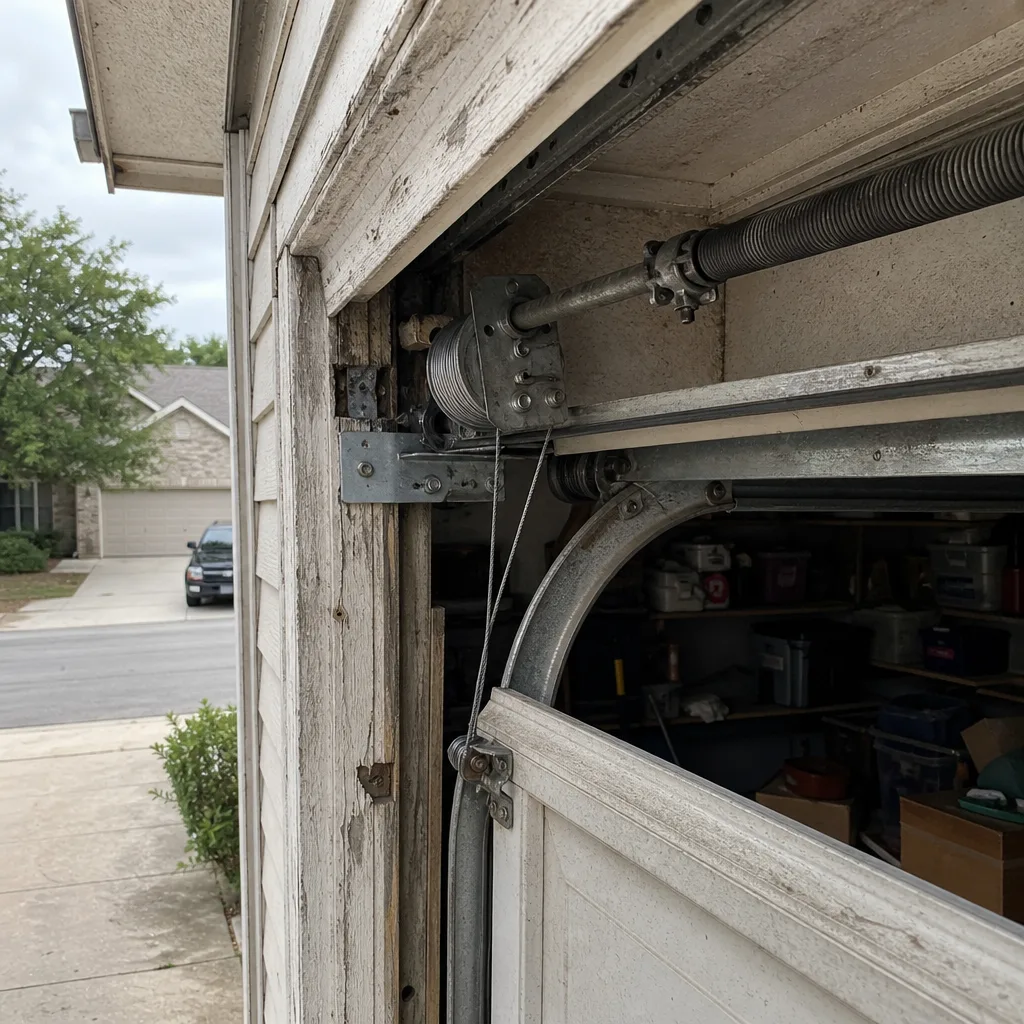 Before
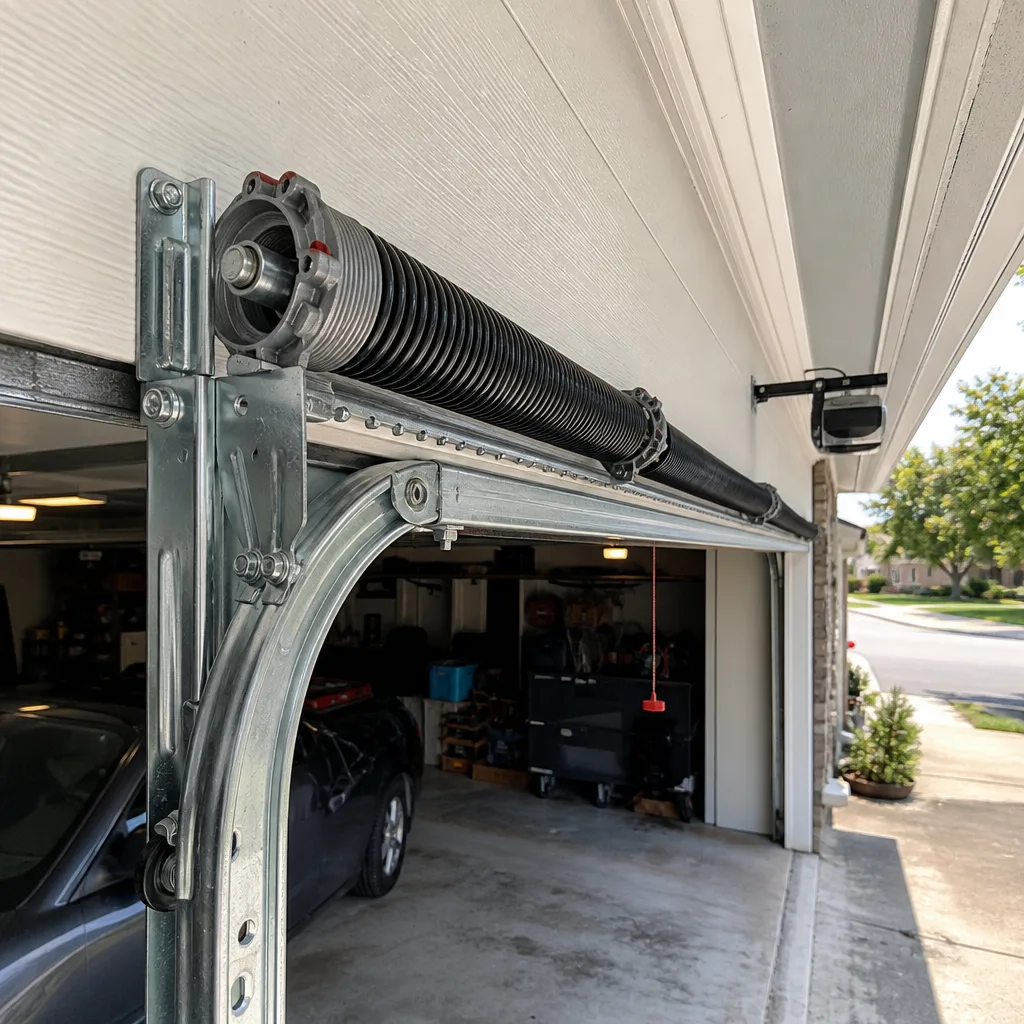 After
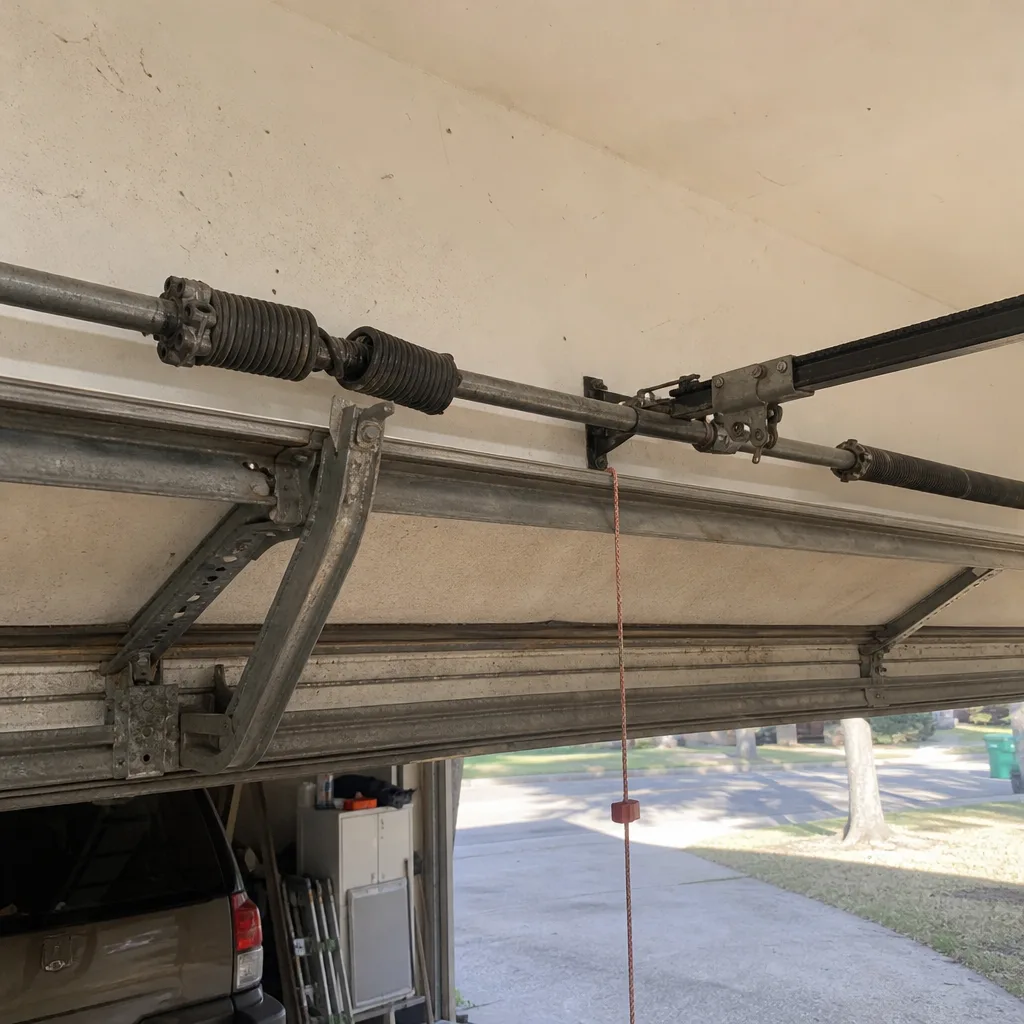 Before
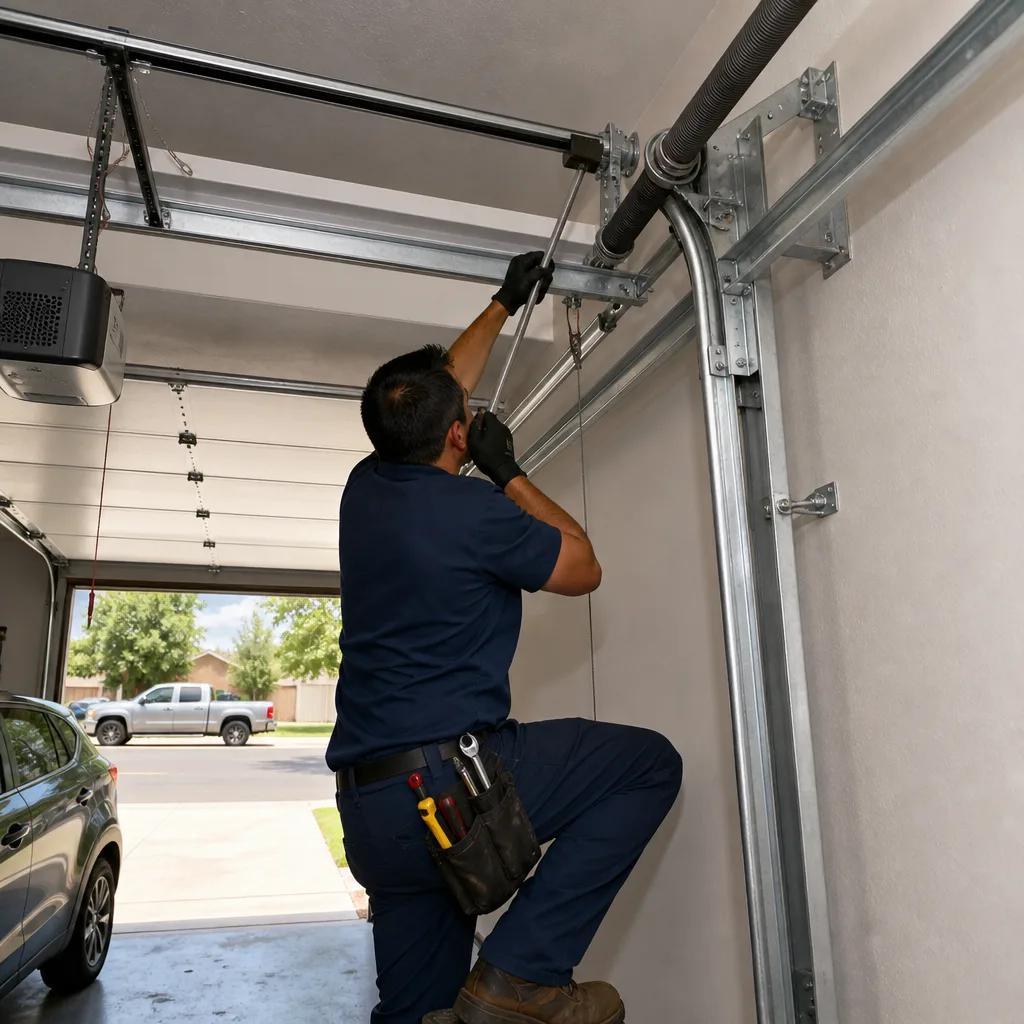 After
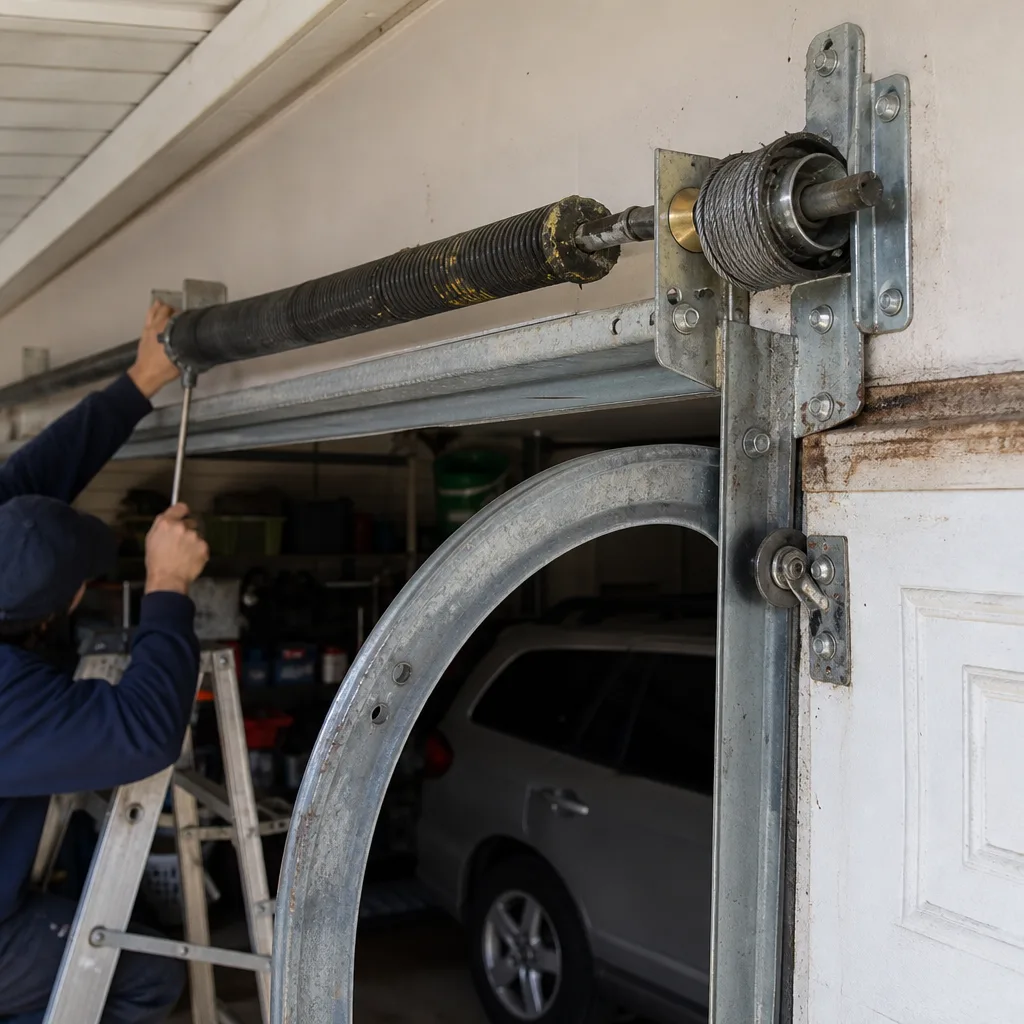 Before
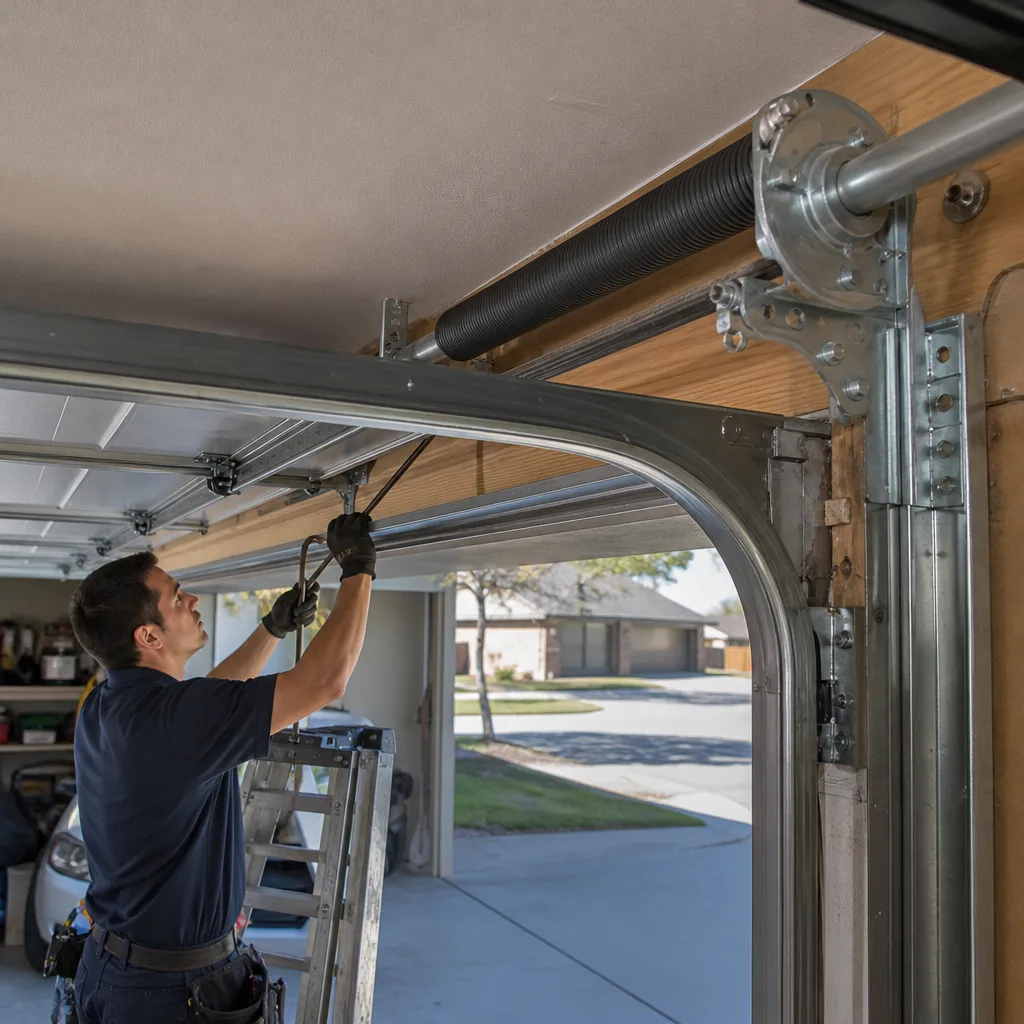 After
When to Call a Professional
There is no shame in calling. In fact, the homeowners we respect most are the ones who know the boundary between what they can do and what they should hand off. Call a professional if your spring shows a visible gap, if your cables look frayed, if your door won’t balance in the halfway position, if your opener is making a grinding sound, or if you’ve completed the safe maintenance tasks and the door still isn’t right. These are not situations where more YouTube will help. Each one is either dangerous, time-sensitive, or likely to get more expensive the longer it waits. Goldleaf Garage Door Repair offers free estimates in Brushy Creek – call (855) 412-0407 and we’ll give you a clear diagnosis and an honest recommendation, whether that’s a repair, a full garage door installation, or just a conversation about what you can continue to do yourself.
Frequently Asked Questions
A torsion spring under full tension stores approximately 400 to 800 pounds of force depending on the door size, and that energy is present even when the door is closed and the opener is unplugged. When a winding bar slips or a set screw fails under load, that bar becomes a projectile. These injuries are not rare – they occur every year in American homes – and they are almost entirely preventable by simply not doing the work without training and proper tools. Call (855) 412-0407 for professional spring service.
Spring replacement in the Brushy Creek area typically ranges from $180 to $320 per spring depending on the door size, spring type, and whether you have a single-door or double-door system. The final price is quoted and agreed before any work begins, so there are no surprises on the invoice. Call (855) 412-0407 and we’ll give you an exact number for your specific door.
Technically possible, but not advisable. The spring itself is only half the job. A correct installation requires measuring the door weight, verifying the spring matches, winding to the specified number of turns, checking cable tension on both sides, testing balance across the full range of travel, and resetting the opener travel limits. Missing any one of those steps results in a door that appears to work but is slowly destroying other components. The spring cost savings almost never offset the downstream damage.
We see more spring failures in Brushy Creek than any other single problem, which makes sense given the age of most housing stock here and the fact that springs are rated for a finite number of cycles. The second most common problem is opener failure caused by years of operating a door that was slightly out of balance. Both are largely preventable with regular inspection and prompt spring service.
Yes. Brushy Creek summers push garage temperatures well above 100 degrees, which accelerates lubricant breakdown and causes metal components to expand. Winter mornings near freezing have the opposite effect. The thermal cycling loosens bolts, degrades weatherstripping faster, and shortens spring life relative to homes in milder climates. Six-month lubrication intervals and quarterly inspections are the right rhythm here, versus the annual maintenance many manufacturers describe.
No. Professional repairs performed to the manufacturer’s specifications preserve your warranty. If anything, a documented professional installation protects a warranty claim by establishing that the door system was correctly balanced and the opener was operating within its design parameters. The warranty risk is on the DIY side: an improper spring installation that leads to opener failure is the exact scenario that manufacturers use to deny claims.
The Bottom Line
The DIY vs. professional question for garage doors is not about your competence, your courage, or your commitment to saving money. It’s about energy. Components that sit inert – rollers, sensors, remotes, weatherstripping, track bolts – are yours to maintain, and doing so will extend your door’s life and save you real money. Components that store force – springs, cables, and anything bolted to them – belong in professional hands, not because the work requires genius, but because the penalty for a small mistake is measured in hospital visits and destroyed openers. Know the difference, act accordingly, and your garage door will outlast your patience with it.
Written by the team at Goldleaf Garage Door Repair, serving Brushy Creek since 2012.