
Wayne Dalton Garage Door Repair in Brushy Creek: A Homeowner’s Guide
Wayne Dalton garage door repair in Brushy Creek usually comes down to one thing most technicians get wrong: the spring system. Wayne Dalton uses a torque-master enclosed spring on many of its residential models, and it requires a specific winding tool and procedure that generalist repair crews don’t carry. So if your Wayne Dalton door is sagging, stuck, or making noise, the fix isn’t generic, and knowing what’s actually on your door before you call anyone will save you a wasted service fee. If you’d rather skip the research and just get it fixed, call (855) 412-0407.
We’ve worked on Wayne Dalton doors all over Brushy Creek, from Cat Hollow to Sendero Springs, and the conversation with homeowners tends to start the same way. Someone’s door stops lifting evenly, they call a company, the tech shows up, looks at the spring, and says the door needs to be “converted.” Here’s what nobody told them: a Wayne Dalton spring system isn’t a defect waiting to be replaced. It’s a different design, and it works fine when you understand it.
What’s Different About a Wayne Dalton Spring System?
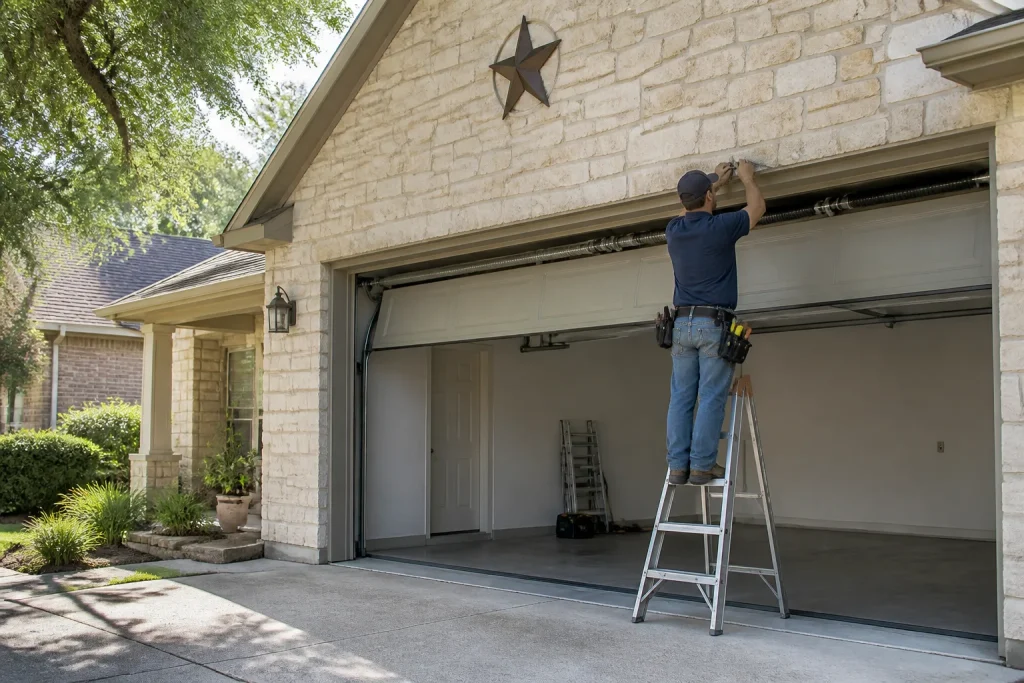
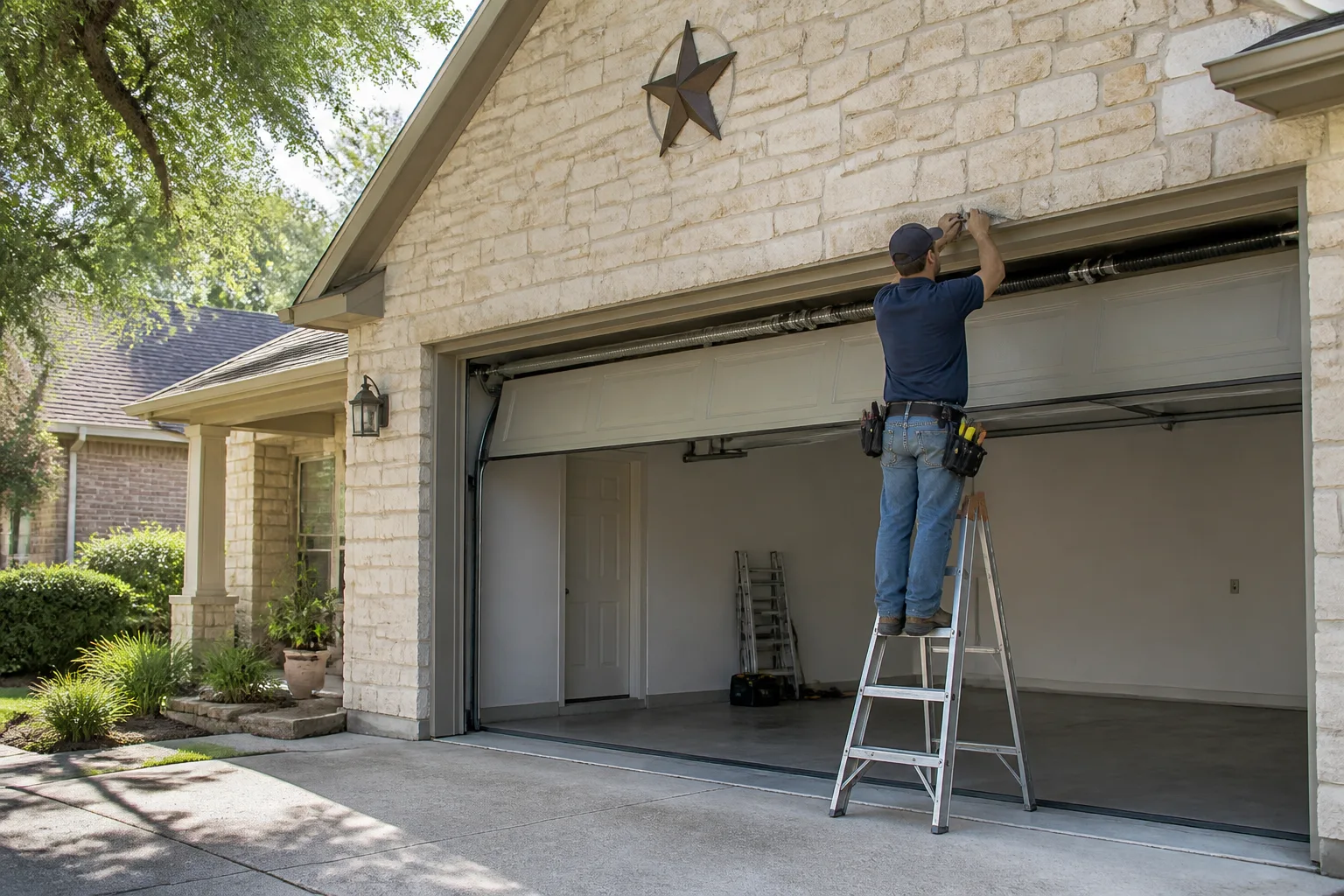
Most residential garage doors use exposed torsion springs mounted on a bar above the door opening. You can see them. Two springs, wound tight, visibly doing the lifting. Wayne Dalton’s torque-master system is different. The springs sit inside a sealed tube. You won’t see coils. You’ll see a smooth tube with two end caps and a rubber bushing in the middle. Internally, two springs work against each other, wound with a proprietary tool that fits into the tube’s winding mechanism.
Why does this matter in Brushy Creek? Because when a technician who only knows exposed torsion springs encounters a torque-master, good outcomes depend on whether they carry the right winding tool. Many don’t. They offer two things instead: conversion to a standard torsion setup, or they attempt a workaround with improvised tools. The first is sometimes legitimate. The second is how doors get damaged and people get hurt. High-tension springs aren’t something to improvise around. We won’t do it, and no homeowner should accept it.
The practical takeaway: when you call for Garage Door Repair in Brushy Creek, ask directly whether the company services torque-master systems with factory or factory-equivalent tools. If the answer is hesitant, call someone else.
Common Wayne Dalton Failures in Central Texas Heat
Wayne Dalton doors are lighter than many competitors. That’s a design choice. The panels are formed steel over insulated cores, built to be easier on openers and easier to lift manually when the power’s out. But the Texas climate works against specific components, and knowing what tends to fail first keeps small problems from becoming big ones.
Here’s what we see regularly in Brushy Creek:
- Nylon rollers wearing out faster than expected. Wayne Dalton doors often ship with nylon-bearing rollers that run quieter but degrade quicker under sustained heat. After enough Central Texas summers, the roller face flattens, and the door starts to rattle and bind. We replace worn rollers on Wayne Dalton doors in Brushy Creek more often than on any other brand we service.
- Bottom section denting from low-impact bumps. The lightweight panels mean the bottom section flexes more than a heavier steel door. A car bumper nudge, a misplaced ladder, a riding mower tap. The damage stays low, but it cracks weather seal seating and eventually lets water and insects in at the slab line.
- Cable drum geometry causing uneven lift. Wayne Dalton cable drums have a different groove profile than standard drums. If a drum is replaced with a “close enough” generic part, the cable doesn’t wind evenly, one side lifts before the other, and the door eats itself over months.
If your Wayne Dalton door shudders on the way up or the bottom edge doesn’t sit level when closed, those are the two most likely culprits: a worn roller set or an incorrect cable drum. Both are fixable same day when the parts are on the truck.
How to Read Your Wayne Dalton Model Number Before Calling
Every Wayne Dalton door has a sticker, usually on the left side of the bottom panel or on the track near the bottom bracket. The sticker carries a model series number like 8000, 9100, 9600, or 9700, plus a serial number and sometimes the door’s exact height and width. This is the single most useful piece of information you can hand a technician over the phone.
Why it matters:
- Spring identification. The model number tells us whether your door uses a torque-master or torque-master plus system, and what spring weight range it shipped with. That’s the difference between us arriving with the correct spring on the truck versus measuring, ordering, and coming back a second time.
- Cable length. Wayne Dalton cables are cut to exact door height specs. A 7-foot door and an 8-foot door use different cables, and guessing is not a thing we do.
- Panel availability. If a bottom section is dented and needs replacement, the model number tells us whether a matching panel is still available or whether the repair should be reframed as a panel swap.
So before you call Goldleaf Garage Door Repair home or anyone else, grab a flashlight, open the garage, and read the sticker. Two minutes on your end saves a second truck roll on ours.
Torque-Master Conversion: When It Makes Sense, When It Doesn’t
Conversions from torque-master to conventional torsion springs are common enough that every Wayne Dalton owner in Brushy Creek should understand the tradeoffs. The honest truth: there are good reasons to convert, and there are lazy reasons to convert.
When conversion makes engineering sense:
- The door is old enough that factory torque-master parts are discontinued or on long backorder. Waiting six weeks for a spring tube is worse than converting.
- The homeowner plans to keep the house for a decade and wants future serviceability from any garage door company, not just ones with Wayne Dalton tooling.
- The door is being upgraded from a lightweight model to something heavier, like a full-vision glass panel or a steel-backed insulated door that exceeds the torque-master’s rated weight range.
When conversion is just convenience dressed up as advice:
- The door is 5 to 8 years old, the torque-master failed once, and the tech doesn’t own the winding tool. That’s a tool gap, not a door defect. A properly serviced torque-master is safe and reliable.
- The tech frames it as “you’ll save money long term” without checking whether your door’s spring rating is actually wrong. Converting a door that doesn’t need conversion adds cost and changes the door’s balance characteristics for no reason.
- Anyone suggests the torque-master is “dangerous.” All garage door springs are dangerous. The torque-master’s sealed design actually contains spring failure better than an exposed torsion system, which is one of the reasons Wayne Dalton engineered it in the first place.
Our position in Brushy Creek has always been straightforward: we service what’s on your door. We carry torque-master winding tools and stock common torque-master spring assemblies. If conversion is genuinely the better long-term call, we’ll tell you why, with numbers. If it’s not, we’ll fix what’s there and leave it alone.
Wayne Dalton iDrive Openers and Modern Opener Compatibility
Between roughly 2003 and 2012, Wayne Dalton sold the iDrive, a wall-mounted, gear-driven opener that bolted directly to the torsion shaft instead of hanging from the ceiling. It was a clever design. It was also discontinued, and today it has a reputation among Brushy Creek homeowners who still have one: hard to get parts for, hard to find anyone who knows it, and increasingly unsupported.
When an iDrive fails, the usual recommendation is replacing it with a modern ceiling-mounted opener from LiftMaster, Chamberlain, or Genie. That’s sound advice. But there’s a catch. The iDrive communicated with the door’s force profile differently than ceiling-mounted openers do. When a modern opener is installed on a Wayne Dalton door, the force settings must be calibrated to the door’s actual weight and travel. Skip that step, and you get a door that slams on close or reverses mid-open, and an opener that burns out its main gear in two years.
This is also where Garage Door Opener Repair in Brushy Creek gets its most common Wayne Dalton-related call. A homeowner replaces an iDrive with a new opener from a big-box store, installs it themselves, and can’t figure out why the safety reversal doesn’t work or the smart-home features won’t connect to the door’s travel sensors. The answer is rarely the opener. It’s the programming.
If you’re upgrading from an iDrive and want to keep your garage functioning as a garage rather than a science project, have the opener installed and force-calibrated by someone who knows Wayne Dalton doors. The opener and the door are one system, and when the two don’t know each other, your panels and springs pay for it.
When to Call a Pro Instead of Watching Another Video
We’re not anti-DIY. In Brushy Creek, we’ve seen homeowners handle simple fixes: lubricating rollers, tightening track bolts, replacing a remote battery. That’s all fine. But a Wayne Dalton door with a failed torque-master spring isn’t a Saturday afternoon project. The spring tube assembly is under enormous tension. The winding process requires the proprietary tool, and getting it wrong can launch components across the garage or drop the door suddenly. Even diagnosing what’s wrong inside the sealed tube is guesswork without experience reading end-cap wear patterns and cable behavior.
Call a professional when:
- The door won’t open past a few inches, even with the emergency release pulled.
- You see a visible gap in the center of the torque-master tube, meaning the internal spring has snapped.
- The door lifts unevenly or drops one side before the other.
- You hear a loud snap from the garage and then the opener just whines without moving the door.
- The cables are slack, frayed, or off the drum.
Related services in Brushy Creek: if the damage is beyond repair and you’re weighing replacement, our Garage Door Installation in Brushy Creek covers full door and opener upgrades. We’ll walk you through what’s current in the Wayne Dalton line, and in comparable options from Clopay and Amarr, so you’re choosing with full information, not a commission sheet.
The Bottom Line
Wayne Dalton garage door repair in Brushy Creek is really about a spring system most companies don’t understand and a door design that behaves differently in Texas heat than it does in the manual. The doors themselves are well engineered. Most of the problems we see come from previous repairs done with the wrong parts, the wrong tools, or the wrong assumptions. If you have a Wayne Dalton door, find a technician who services torque-master systems the way they were designed to be serviced, not one who treats your door like an inconvenience. If you’re in Brushy Creek and need help, Garage Door Repair in Brushy Creek from Goldleaf is one call away. Estimates are free, the phone is (855) 412-0407, and we’ll tell you exactly what’s wrong before any work starts.
Frequently Asked Questions
Most Wayne Dalton repairs in Brushy Creek run between $160 and $430, depending on whether you’re replacing rollers, a spring assembly, cables, or a bottom panel. Torque-master spring replacement is typically $210 to $380 including parts and labor. We quote the exact price before any work begins, so the number we give you on the phone is the number on the invoice. Call (855) 412-0407 for a free estimate.
Yes, and in some cases it’s the right call. If your torque-master is discontinued, parts are unavailable, or the door is being upgraded beyond the spring’s weight rating, conversion makes sense. If the conversion is being suggested because the technician doesn’t have the tool, that’s not a reason to modify your door. We service torque-master systems directly and only recommend conversion when it’s genuinely the better engineering choice. Call (855) 412-0407 and we’ll tell you which situation you’re in.
Shaking is usually worn nylon rollers, and on Wayne Dalton doors in Brushy Creek, heat accelerates that wear. The second most common cause is a cable drum that was replaced with an incorrect part, which causes the door to lift unevenly and rattle as it compensates. Both are fixable same day with factory-correct parts, and the repair is far cheaper than waiting until a cable snaps and the door comes off track. Call (855) 412-0407 for a diagnosis.
Honest answer: sometimes, but most iDrive openers are now beyond practical repair because replacement parts are no longer manufactured. What we do in Brushy Creek is assess the unit, and if it’s not fixable, install a modern opener from LiftMaster, Chamberlain, or Genie, then force-calibrate it to the Wayne Dalton door. That calibration step is what prevents safety reversal failures and door damage down the line. Call (855) 412-0407 and we’ll look at what you have.
Written by the team at Goldleaf Garage Door Repair, serving Brushy Creek since 2012.
Need Garage Door Help?
Call Goldleaf Garage Door Repair — licensed & insured, here with fast after-hours help in Brushy Creek.
(855) 412-0407